 Announced a little over two years ago, the transition to USB-C connectivity for all Yoctopuce modules is now officially complete. This is a good opportunity to take stock and explain how we see the future. If you still absolutely need modules with Micro-B connectors, reading this post carefully will likely put your mind at ease.
Micro-B vs. USB-C
The first question you might ask is: aside from the connector, is there a fundamental difference between the Micro-B and USB-C versions of the same Yoctopuce module? The answer is no. You can replace a Yoctopuce Micro-B module with its USB-C version; your applications based on that module will work just as well without recompilation, provided you haven't had the funny idea of hard-coding the model name of the required modules. Despite their modern connectors, the USB-C versions of Yoctopuce modules continue to operate in USB 1.1 mode, which ensures compatibility with all USB ports ever made. Your computer doesn't have a USB-C port? No problem, you can easily use a USB-A-to-USB-C cable. Similarly, you can easily use a USB-C-to-Micro-B cable to connect a module to a YoctoHub.
Advantages
Compared to the Micro-B versions, the USB-C modules offer several advantages:
- The connector is reversible. You no longer have to carefully examine the connector and the socket to connect your module correctly. Note, however, that this isn't necessarily a major innovation, since there are also reversible USB Micro-B cables (really!).
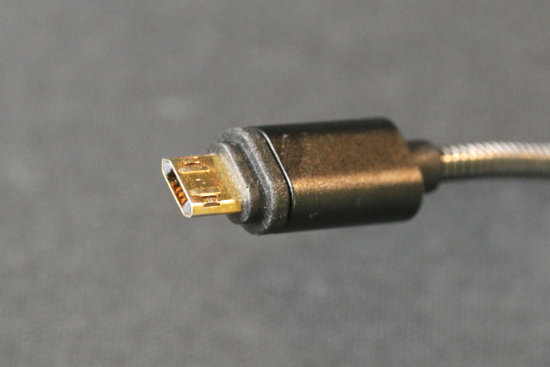
A reversible Micro-B cable - Because it's a through-hole component, the USB-C connector is more sturdy. Some customers with heavy hands did indeed tend to pull out the Micro-B connectors, which were only surface-mounted.
- In our experience, USB-C plugs generally hold more securely than Micro-B versions; this is immediately noticeable in applications subject to vibrations.
- USB-C plugs are generally slim enough to allow you to connect a module flush against a surface. In other words, you no longer necessarily need spacers, and you can easily create "low-profile" setups.
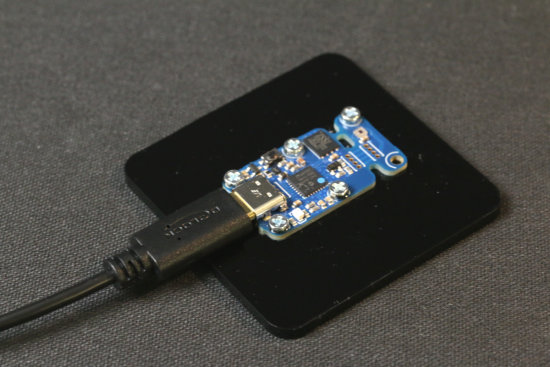
Don't try to do this with a Micro-B cable
Drawbacks
The USB-C connector has quite a few advantages over the Micro-B version, but it also has a few drawbacks.
- Size: USB-C female connectors are larger than their Micro-B counterparts, which caused us a few problems, but we managed to fit them in without changing the modules' geometry. The Yoctopuce USB-C modules are therefore compatible with existing Yoctopuce enclosures, which wasn't a given. However, be sure to check the openings for the USB ports on your front panels.
- Cost, but not that of the connector: we realized that USB-C connectors only cause a marginal increase in the price of the modules. What increases significantly is the price of USB cables. This isn't really surprising, given the increased complexity. However, we can expect USB-C cable prices to drop over the long term.
- Certifications: The EMI tests we've conducted so far show that a Yoctopuce USB-C module performs slightly better than its Micro-B equivalent. But strictly speaking, if you're using Yoctopuce modules in a commercial device that you've had certified, you should, in theory, have the device certified again if you replace the modules it contains. Note that from an EMI standpoint, we've observed that, unlike Micro-B cables, most USB-C cables on the market are manufactured correctly.
Current status
Here is a list of all affected products
Although transition to USB-C is complete, this does not necessarily mean that all existing modules have been converted to USB-C in exactly the same way; there are a few exceptions.
Yocto-Light-V3 and Yocto-Light-V4
Ambient light sensors Yocto-Light-V3 and Yocto-Light-V4 have not been converted: these two modules are best replaced by the Yocto-Light-V5 and Yocto-Light-V5-C, which are both based on an Texas Instruments OPT4003 sensor. The V3 is based on ROHM BH1751FVI sensor, which is no longer in production; the module will be discontinued once we have clear out of our stock of sensors. The V4, based on a OPT3004 sensor, duplicates the functionality of the V5 and will also be discontinued once we have clear out of our stock of OPT3004 sensors.
Yocto-Display and Yocto-MiniDisplay
The Yocto-Display and Yocto-MiniDisplay have not been updated because we do not sell enough of them to justify the necessary investment. The Yocto-MaxiDisplay, however, has been updated to Yocto-MaxiDisplay-C.
Yocto-VOC-V3
The Yocto-VOC-V3 is about to be discontinued following Sensirion's decision to halt production of the SGP30 sensor. The good news is that we've found a replacement sensor, and a Yocto-VOC-V4-C should be announced shortly.
Yocto-Watt and Yocto-4-20mA-Tx
Some modules, such as the Yocto-Watt and the Yocto-4-20mA-Tx, have been directly replaced by new, higher-performance versions available exclusively with USB-C connectivity: namely the Yocto-Watt-V2-C and the Yocto-4-20mA-Tx-V2-C.
Micro-USB-Hub-V2
The Micro-USB-Hub-V2 has not been updated. Since its Micro-USB connector is intended to be removed by the user, we did not see the need to replace it with a USB-C connector. The Micro-USB-Hub-V2 will therefore remain available as is. However, we have a few ideas for a new small USB hub in the USB-C format, specifically designed to facilitate the integration of Yoctopuce USB-C modules.
Yocto-Thermistor-C
Contrary to what its name might suggest, the Yocto-Thermistor-C is not a USB-C module; it's a Yocto-MaxiThermistor with a larger terminal block that allows you to use of thicker wires but with a common ground connection, hence the "C" suffix. This module was created a long time ago at the request of a customer who has since stopped buying them. We hardly sell any of them anymore, and they will be discontinued in the medium term, but you can still use the Yocto-MaxiThermistor-C.
The YoctoHubs
The YoctoHub-Ethernet, YoctoHub-Wireless-n, YoctoHub-GSM-4G, and YoctoHub-Shield have not been converted because we have much more ambitious plans for them than simply changing the connector. Once again, the current versions work perfectly with USB-C modules: you just need a Micro-B to USB-C cable
What the future holds
Now let's address the question that might be on your mind: What does Yoctopuce plan to do with the Micro-B modules? Rest assured, for the time being, not much is going to change.
- The Yoctopuce online shop now offers USB-C versions by default, but the Micro-B versions are, of course, still available.
- Future Yoctopuce modules will only be available in USB-C versions.
- That's all.
In one year, starting in July 2027, Yoctopuce will stop systematically stocking the components needed to manufacture the Micro-B versions and will allow existing stocks to run out naturally.
However, even once these stocks are depleted, it will still be possible to purchase the Micro-B versions as long as they can be manufactured, but minimum order quantities will apply. This MOQ will be based on the number of modules that can fit on 10 boards measuring approximately 30x15 cm. For example:
| Micro-B Module | Size | MOQ |
|---|---|---|
| Yocto-light-V5 | 20x35mm | 360 pieces |
| Yocto-Relay | 20x45mm | 300 pieces |
| Yocto-Amp | 20x56 mm | 240 pieces |
| Yocto-Watt | 50x58 mm | 100 pieces |
| Yocto-MaxiPowerRelay | 58x59 mm | 80 pieces |
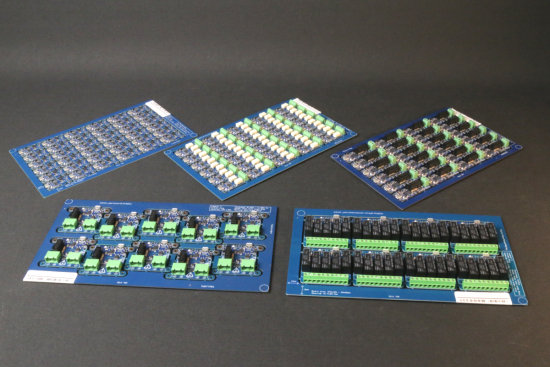
Here are a few images of finished modules to help you understand the MOQs
To summarize
All around the world, the USB Micro-B standard, which has been advantageously replaced by USB-C, is gradually being phased out. Yoctopuce has followed this trend by opting for a gradual three-year transition, while still offering a reasonable option to stick with Micro-B for customers who have invested too heavily in this standard to afford a quick switch. We hope this works out for everyone....