How to measure a NTC thermistor via USB
 Yoctopuce provide three different methods to measure temperature, but there are even more techniques. Thermistors are another option: they are a family of electrical conductors whose resistance varies in a deterministic way based on their temperature, and that can therefore be used to measure temperature. So can we get anything out of them, for instance using a Yocto-Knob?
| No comment yet | Read more... |
How to use USB devices from Qt framework
 A customer noticed a few days ago that our C++ library was not compiling under Qt / MinGW under Windows (although OSX and Linux were OK). We have published a fix on GitHub, but we realized that we never talked about Qt on our site. Never too late... Qt is a cross-platform graphical programming framework, that can build binaries for multiple OS. We will demonstrate that with a small program that opens a window to list connected Yoctopuce modules. Thanks to the Qt framework, the exact same project will be usable for Windows, Linux and Mac OS X.
| No comment yet | Read more... |
How to turn on a computer remotely
 Tablets and other small media players, that enable you to view DivX movies comfortably sprawled on your couch, have relegated to the closet wholesale Media Centers that hummed loudly in the living room. If this new solution is more elegant and less noisy, it doesn't solve all the issues: you must still have somewhere a real machine storing your movie library. Either it is always on, which is not very rational, or you must turn it on and off before and after, which does kill the magic. So, how do we power a computer remotely from the couch?
| No comment yet | Read more... |
Yoctopuce and the Mono framework
 Some time ago, someone asked us if we had planned a Yoctopuce library for the Mono framework. We didn't have such plans, however we promised to have a look at it. Let's do that together, shall we ?
| 5 comments | Read more... |
A standalone RSS reader
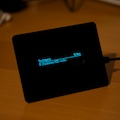 Until a few weeks ago, our Yocto-Display required to be connected by USB to a computer in order to update the screen. Now that the YoctoHub-Ethernet has been released, we can free ourselves from this limitation. Here is how to display the content of an RSS feed on a Yocto-MaxiDisplay connected to a YoctoHub-Ethernet, using the PHP API in HTTP Callback mode.
| No comment yet | Read more... |
1 ... 10 ... 20 ... 30 ... 40 ... 50 ... 60 ... 70 ... 80 ... 90 ... 100 ... 110 ... 120 ... 130 ... 132 133 134 135 136 137 138 139 140 141 142 ... 150 ... 159