 This week, Yoctopuce once again presents two new additions to the USB type-C module family. They are the Yocto-MaxiThermistor-C and the Yocto-Color-V2-C. Let's take a closer look, shall we?
The Yocto-MaxiThermistor-C
The Yocto-MaxiThermistor-C is the USB-C equivalent of the Yocto-MaxiThermistor, a module capable of interfacing up to six thermistors. A thermistor is a small resistor whose resistivity changes predictably depending on the temperature. In other words, the Yocto-MaxiThermistor-C is a multi-channel temperature sensor. It comes with six small Murata NXFT15XH103 thermistors, but you're free to use any you like, as long as you know their characteristics and enter them in the Yocto-MaxiThermistor-C configuration.
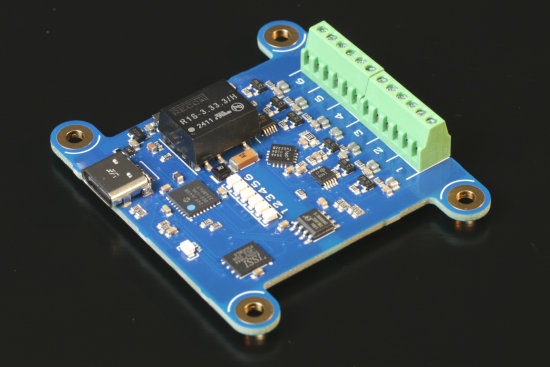
The new Yocto-MaxiThermistor-C
In essence, the Yocto-MaxiThermistor-C is nothing more than a rather accurate ohmmeter that automatically converts resistance values into temperature. Knowing that who can do more can do less, you can configure the Yocto-MaxiThermistor-C to give you resistance values rather than temperature, and use it to directly measure resistances between 100Ω and 500KΩ. Note that the measuring part is electrically isolated from the USB part, so there's no risk of ground loops, but all six inputs share a common ground.
There is one small limitation that you need to be aware of: the six inputs are not measured simultaneously, but in turn, which explains the relatively low refresh rate of 1Hz for each channel.
Be careful not to confuse the Yocto-MaxiThermistor-C with the Yocto-Thermistor-C, which is a Yocto-MaxiThermistor with a larger terminal block that allows thicker wires to be used, but which has only one input for ground. In retrospect, the choice of this name is a bit unfortunate, but we have no plans to make a Yocto-Thermistor-C-C. We don't sell enough Yocto-Thermistor-Cs to justify a USB-C version of the version with the large terminal block.
In terms of price, we've realized that the production cost of the Yocto-MaxiThermistor has come down a bit, so we've lowered its price from CHF 100.70 to CHF 97.00 and priced the Yocto-MaxiThermistor-C at CHF 97.20.
The Yocto-Color-V2-C
The Yocto-Color-V2-C is the USB-C version of the Yocto-Color-V2, one of Yoctopuce team's darlings. This little module controls RGB LEDs and makes any concept based on light signage quite trivial. The module allows individual control of up to 512 "smart" LEDs of types WS2812B, WS2812C, SK6812, WS2811, SK6812RGBW, and so on. These LEDs are not ordinary RGB LEDs, they can be wired in series and still be controlled individually. In addition to power and ground pins, each of these LEDs has an input pin and an output pin for a digital control signal. The Yocto-Color-V2-C generates this signal, which is then transmitted from one LED to the next, provided that each output pin of one LED is connected to the input pin of the next.
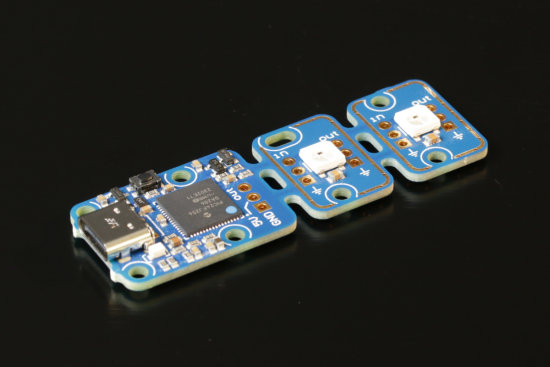
The Yocto-Color-V2-C
The Yocto-Color-V2-C houses two RGB smart LEDs, but the circuit has been designed so that it can easily be cut into two or three pieces to allow the LEDs to be moved. Of course, you can add up to 512 more. At full power, each of these LEDs can consume up to 50mA, so if you add a lot they may well consume more than what a USB2 port can supply, and you'll need to provide an independent power supply for the LED chain.
Yoctopuce doesn't sell additional smart-LEDs, but as this type of LED is very popular in the DIY world, it's easy enough to get ready-made LED panels, for example from Adafruit, which sells its own under the Neopixel brand.
The Yocto-Color-V2-C also allows you to pre-program small animated sequences that are entirely controlled by the module. You pre-program one of these sequences using a computer, then disconnect the module from the computer and power it up with a USB charger, and the animation runs. This feature allows you to install dynamic lighting in your DIY projects. This animation system also makes it possible to build luminous watchdog systems that change color when a process has crashed. Believe it or not, it's extremely useful :-)
Note that the stand-alone animation system can only handle the first 150 LEDs, as the CPU doesn't have enough resources to do more.
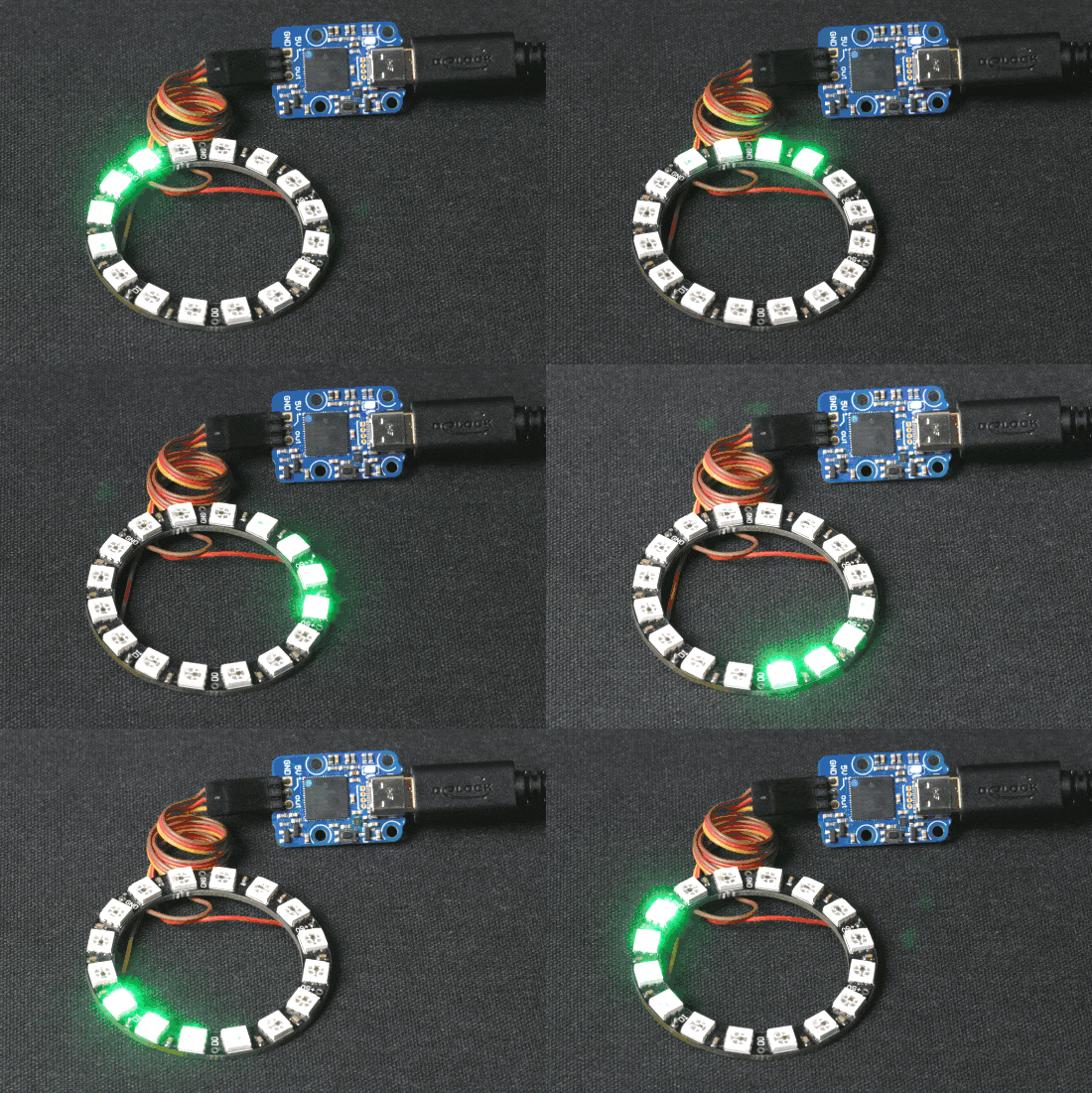
The Yocto-Color-V2-C can handle autonomous animations
The bad news is that the production cost of the Yocto-Color-V2 has risen sharply since its launch in 2016. True to our principles, we won't be touching its CHF 24.90 price tag. However, as usual, we've set the price of the C version at three times its component cost, that is CHF 29.70.
Well, that's all for this week.