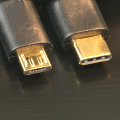
 Once again this week, Yoctopuce is announcing two new module conversions to USB-C connectivity: the Yocto-Serial-C and the Yocto-SPI-C. Functionally, these two modules are quite similar since they're both used to manage a serial connection, but let's take a closer look, shall we?
Yocto-Serial-C
The Yocto-Serial-C allows you to communicate with a system using a TTL serial signal. You can choose to use either a 5V or 3.3V signal. The Yocto-Serial-C also provides a small independent power supply configurable for 3.3V or 5V, allowing you to power the component you wish to communicate with, and even use different voltages for the power supply and the signal. Be careful not to confuse a TTL serial signal with an RS232 signal, which, although very similar, uses negative voltages.
TTL serial signals are often used within the same device to communicate with subsystems that already contain a processor. For example, a bar code reader, a ticket printer, a fingerprint reader, a particle sensor, and the list goes on.
You can, of course, use the Yocto-Serial-C to explicitly send and receive data from your code, but the Yocto-Serial-C can do much more. It contains a system of autonomous jobs: you can write small scripts that are executed by the module and that can, for example, query a sensor and present the result in the style of a Yoctopuce sensor, with all the associated benefits: data logger, compatibility with the YSensor class of the Yoctopuce API, compatibility with Yocto-Visualization, and so on.
The Yocto-Serial-C also offers one of those small features that might seem useless until the moment you need it: you can connect the module to a serial communication line and observe what's happening there. This way, you can easily debug erratic communication or even do a bit of reverse engineering on a mysterious protocol.
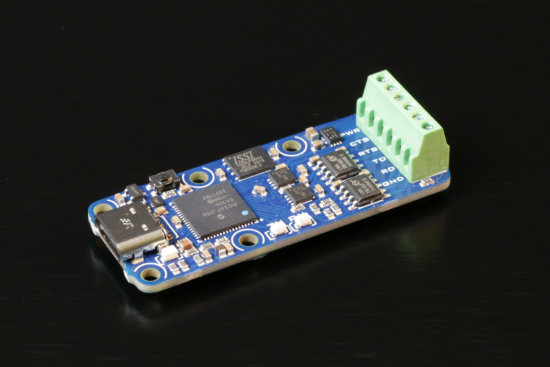
The Yocto-Serial-C
In terms of price, the Yocto-Serial-C costs CHF 58.60, which is 60 cents more than the Micro-B version.
Yocto-SPI-C
On a modern electronic board, you almost always find a processor and peripherals such as sensors or memory. To communicate with these peripherals, two types of buses are extremely popular: I2C (Inter-Integrated Circuit) and SPI (Serial Peripheral Interface). The advantage of the I2C bus is that it requires only 4 wires, including power; it is, however, relatively slow, operating at around 400 kHz. The SPI bus, on the other hand, requires at least 6 wires, but it is capable of fairly high speeds in the range of several MHz.
The Yocto-SPI-C is therefore an interface that allows you to connect SPI devices; its features are quite similar to those of the Yocto-Serial-C. You can choose the signal voltage between 5V and 3.3V, and you have a small independent power supply capable of providing 200mA at 5V or 3.3V. And just like with the Yocto-Serial-C, you can create small scripts that are executed by the module and can handle querying SPI sensors, performing some calculations, and presenting the results in the same way as a standard Yoctopuce sensor. You can also connect the Yocto-SPI-C to an existing SPI bus and observe what is happening there.
Scenarios requiring direct interfacing of an SPI bus via a USB interface are rarer than with a TTL serial bus. However, the Yocto-SPI-C proves extremely useful when evaluating an electronic component with an SPI interface to determine whether it lives up to the manufacturer's claims and is suitable for a specific project.
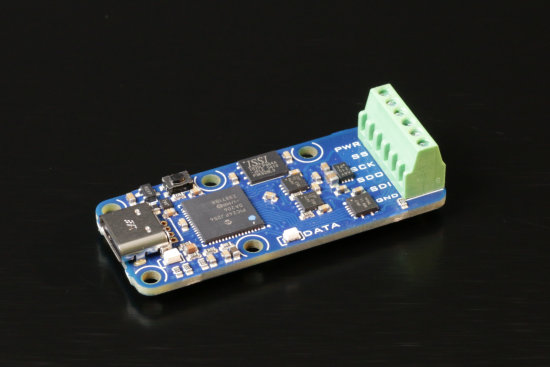
The Yocto-SPI-C
The price of the Yocto-SPI-C, calculated as three times the cost of its components, is CHF 44.50. We took this opportunity to note that the manufacturing cost of the Yocto-SPI has dropped slightly since 2016, so we've lowered its price from CHF 48.20 to CHF 44.20.