 This week, Yoctopuce announces two new USB-C module conversions: the Yocto-Servo-C and the Yocto-MaxiKnob-C. Let's take a closer look at them, shall we?
The Yocto-Servo-C
The Yocto-Servo-C is a tiny module designed to control model servos or any other accessory compatible with the standard control signals used in model making, such as an electronic speed controller (ESC). The typical control signal in the world of radio-controlled models is a PWM at about 30Hz with a duty cycle that varies between 1 and 2ms and a neutral position at 1.5ms.
Not only does the Yocto-Servo-C allow you to command an immediate change in the position of a servo, which forces the servo to move to the requested position as fast as its mechanics allows, but you can also command gradual position changes: you specify the position and the time to reach it, and the Yocto-Servo-C manages the transition on its own. You can also reconfigure the neutral position and increase the duty cycle beyond 2ms to work with servos that deviate slightly from the standard.
The Yocto-Servo-C can power the servos using only the USB bus, but it is important to note that, despite its USB-C connector, the Yocto-Servo-C is a USB 1.1 module and is not capable of handling the Power Delivery function of USB 3. Therefore, you can expect to get between 0.5 and 3A from a USB 1.1 host, which limits you to small servos that don't consume too much power. However, you can circumvent this limitation: the Yocto-Servo-C offers you the possibility of using an external power supply.
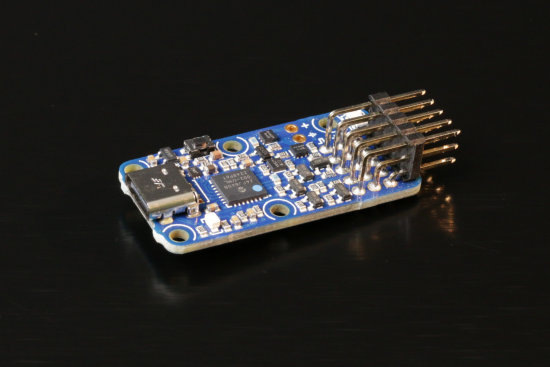
The Yocto-Servo-C
In terms of price, the Yocto-Servo-C costs CHF 25.60, which is CHF 3.70 more than the Micro-B version, due to a few specific components for which the price has increased slightly over the past fifteen years.
The Yocto-MaxiKnob-C
The Yocto-MaxiKnob-C is the big brother of the Yocto-Knob-C. Instead of 5 analog inputs for interfacing switches, push buttons, potentiometers, and other resistive sensors, it has twelve. These inputs can also be configured to decode quadrature signals, allowing you to interface with encoders of the same name.
Unlike the Yocto-Knob-C, the inputs are not available in the form of a screw terminal block, but in the form of a 2x12 contact header, so you need cables with the appropriate connectors. Yoctopuce offers a small assortment of excellent quality connectors in its online shop, but you can also find cheaper ones elsewhere, as this type of connector is very common.
The Yocto-MaxiKnob-C has an RGB LED that can be chained with other smart LEDs such as WS2812B, WS2812C, SK6812, WS2811, or SK6812RGBW, also known as NeoPixel. You can control the color of each LED individually and even pre-program small animations.
Finally, the Yocto-MaxiKnob-C has a small buzzer that allows you to emit sounds at the frequency of your choice, and even play a few simple tunes.
In short, the Yocto-MaxiKnob-C contains everything you need to build a physical user interface with the ability to interface all kinds of buttons and provide both sound and light feedback.
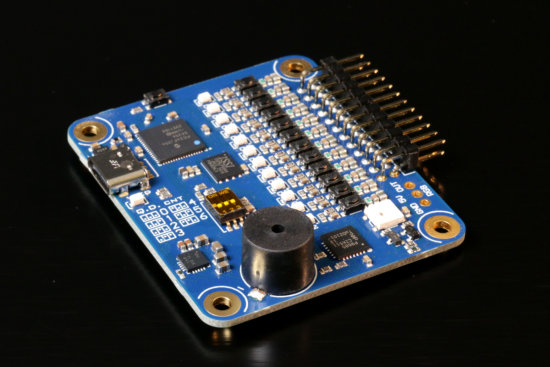
The Yocto-MaxiKnob-C
The price of the the Yocto-MaxiKnob-C, calculated as three times its component cost, comes to CHF 82.50, which is slightly cheaper than the Yocto-MaxiKnob.