 This week, Yoctopuce is announcing two new conversions to USB-C: the Yocto-MaxiMicroVolt-Rx-C and the Yocto-Altimeter-V2-C.
Yocto-MaxiMicroVolt-Rx-C
The Yocto-MaxiMicroVolt-Rx-C is a somewhat specialized product designed in 2019 at the request of customers. The module is able to measure voltages between -2 and +2V with an accuracy of 1µV, hence its name. This level of accuracy is required when working with some electrochemical gas sensors. The Yocto-MaxiMicroVolt-Rx-C has four channels that allow you to connect up to four sensors; however, if you use multiple sensors, they are queried sequentially rather than in parallel.
Additionally, it includes a small 4.7V power supply to power the sensors if needed. It also has an input for connecting a thermistor to measure the temperature of your experiment; this is important because temperature can potentially have a direct influence on the behavior of electrochemical processes.
Note that unlike other Yoctopuce electrical sensors, the Yocto-MaxiMicroVolt-Rx-C is not isolated: you must be able to connect together the ground of your sensors and that of the USB bus of your computer, which shouldn't be a problem.
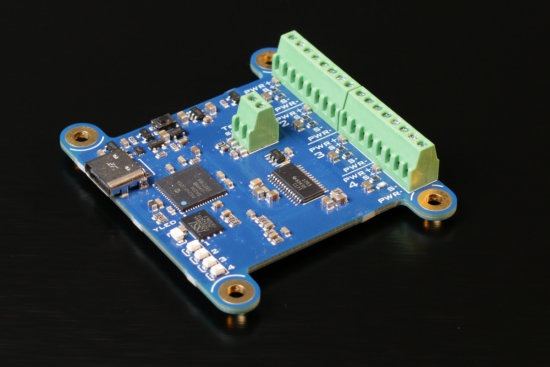
Yocto-MaxiMicroVolt-Rx-C
If you're observant, you may have noticed that the Yocto-MaxiMicroVolt-Rx-C bears a strong resemblance to the Yocto-MaxiBridge-C. That's normal: it's the same hardware with just a different firmware, which explains why the Yocto-MaxiMicroVolt-Rx-C is at the same price, that is CHF 113.50, and a few francs less than the Micro-B version. If you're wondering why the Yocto-MaxiMicroVolt-Rx-C is so expensive, it's mainly due to the ADS1263 analog-to-digital converter required to achieve the advertised accuracy; it's a high-end component that has fully met our expectations, but it's insanely expensive.
Yocto-Altimeter-V2-C
From a hardware standpoint, the Yocto-Altimeter-V2-C is simply a Yocto-Meteo-V2-C without a humidity sensor, but the API is completely different: it is designed to easily measure the module's altitude relative to sea level. Like most altimeters, it uses a barometric sensor. It simply calculates an altitude offset based on a difference in atmospheric pressure: if you provide the Yocto-Altimeter-V2-C with the atmospheric pressure at sea level, known as QNH, it can deduce its altitude based on the difference from the pressure at its current location. This calculation also depends on the temperature, which is why the Yocto-Altimeter-V2-C also features a temperature sensor with published measures in case you need them.
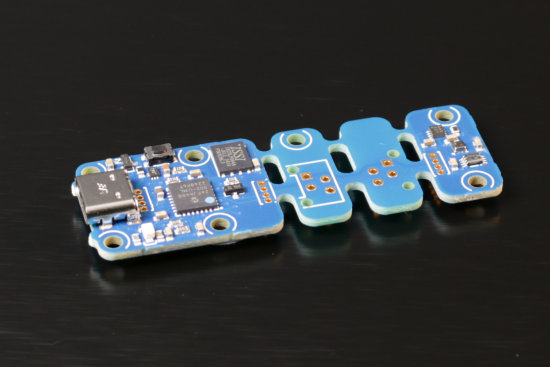
Yocto-Altimeter-V2-C
However, it is important to realize that measuring estimating altitude based on barometric pressure is a technology that, although ubiquitous, has limitations that are easily reached. Since meteorological conditions at a given location are constantly changing, a barometric altimeter tends to drift rapidly and must be calibrated regularly. On the other hand, the good news is that the ICP-10100 sensor used in the module has a relatively low intrinsic drift. In other words, if you place two Yocto-Altimeter-V2-C sensors side by side, they should drift in the same way depending on weather conditions. It is therefore possible to use two sensors, one placed at a known reference position and the second one that moves. A simple calculation of the height difference between the two sensors thus cancels out the drift caused by weather changes... provided that both sensors remain in similar environments, particularly in terms of temperature.
The module can easily be split into two parts so that you can move away the sensor part. This allows you to expose the sensor part to the ambient air while keeping the USB part in a more protected location.
We end this post with a pleasant surprise: the price of the Yocto-Altimeter-V2-C, calculated as three times the cost of its components, comes out at CHF 30.60, that is 6 francs less than the Micro-B version. We've therefore adjusted the price of the Micro-B version to CHF 30.40 :-)