 After 15 years of loyal service, our first autoplacer robot is reaching the end of its life. It's still working well, but given the difficulty in sourcing replacement parts, the manufacturer informed us this Spring that its support contract would end at the end of the year. So we had to break open our piggy bank to upgrade this key piece of equipment in our production process...
As a reminder, the autoplacer robot is the machine that places electronic components one by one onto the PCB (printed circuit board), which has been pre-coated with solder paste via screen printing. The components are supplied on reels arranged on all four sides of the machine, and a robotic head picks them up one by one to place them in the correct location and orientation on the circuit: this is the pick-and-place process. If you'd like to learn more, check out (or revisit) our series of posts from 15 years ago describing the assembly of Yoctopuce modules, complete with an explanatory video.
The new autoplacer robot arrived at our facility in early June:
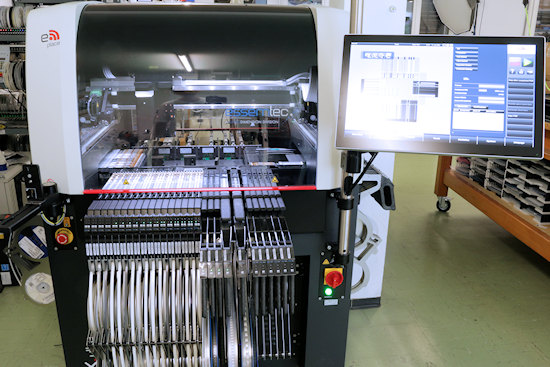
Our new autoplacer robot: an Essemtec FOX2 Ultra
We chose to stick with a Swiss-made machine manufactured by Essemtec, the maker of our first robot. Technology has advanced significantly over the past fifteen years, and this new machine offers many advantages over the previous one:
- a placement head with a dual nozzle, which cuts the number of head movements in half
- faster, higher-density, and more precise component feeders, equipped with indicator lights
- an optical component recognition and alignment system that is faster and more precise
- linear motors instead of belt drives, which are faster
- greater precision in component pickup, recognition, and placement
- Improved traceability of completed assemblies
Component feeders are of great importance, both in terms of functionality and cost: they account for nearly half the machine's cost. To take advantage of the improvements offered by the new system, we chose to upgrade all the feeders used in many of our products. However, we took advantage of the fact that the manufacturer offers the option to use older-generation feeders on this new machine, thereby saving us the cost of replacing feeders that are used only in a few specific products, which represents a considerable savings.
Starting production of our projects on the new robot went remarkably well. Before the machine arrived, we spent a month adapting our project and component modeling workflow to generate files in the format required by the new machine. Once the machine was on site, after just two days of training and process adjustments, we were able to launch the first production runs:
Fun fact: the machine is so powerful that we chose to limit its operating speed to 60% of its maximum to prevent the building's floor from vibrating and disturbing our neighbors. It can actually operate at nearly twice the speed shown in the video above... Additionally, to give you a better view of the process in the short video, we intentionally slowed down the placement of the last component (the USB connector) and enabled traceability pictures.
Based on these initial runs, we've found that, as we're using it, the new machine is twice as fast as the previous one. It requires fewer interventions during production thanks to the improved feeders and has significantly less trouble placing the components that posed problems for our first machine. Optical component alignment by comparing the ideal polygon-based model of the component with its actual picture is remarkably effective and reliable. Here, for example, is our model of an SiA421DJ transistor:
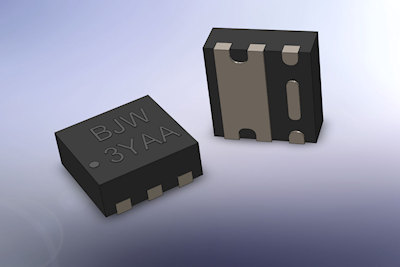
Our 3D model of an SiA421DJ transistor
And here is how the machine matches the theoretical model of the footprint of this transistor with the image captured by the camera:
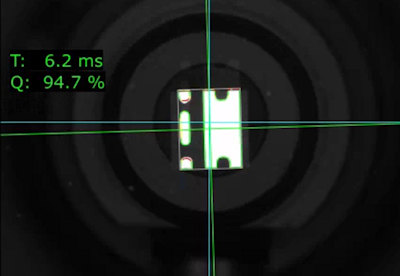
Optical alignment of the contacts on a SiA421DJ transistor
The coming weeks will reveal whether these initial successes hide any unexpected difficulties, but at first glance, it appears we'll be able to switch our entire production over to the new machine without delay, thereby significantly increasing our production capacity at the same time.