 With the disappearance of incandescent and halogen bulbs due to their poor energy efficiency, we're being encouraged to replace the bulbs in our lamps with equivalent LED bulbs. But if you're used to dimming your lights with a dimmer switch, you've probably noticed that your existing dimmer often doesn't work well with these new bulbs. Why is this, and how can we fix it?
To understand the problem, you need to know that an LED bulb works very differently from previous technologies.
How a bulb works
To light an old bulb, all you have to do is pass electricity through the bulb, whose filament is a simple conductor: regardless of the voltage or current characteristics, as long as you pass enough energy through the bulb's filament - and not too much so that it doesn't burn out - the bulb lights up. In particular, this means that older bulbs can be powered directly by mains current, without the need for any additional electronics.
For LED bulbs, it's a different story. An LED is polarized and only lights up over a very restricted voltage range. Below the specified voltage range, the LED stays off and doesn't conduct; above, it burns out. As a minimum, therefore, the AC voltage must be rectified, regulated, and the current flowing through the LED limited by electronic components. In the case of new LED bulbs, which resemble old bulbs, these components are hidden in the base of the bulb, or in the plastic support for halogen bulb replacements. For reasons of cost, these control electronics are often very simple, and assume that the voltage supplied to them is a nice sine wave of around 230 VAC in Europe or 110 VAC in America, as is normally the case with mains voltage.
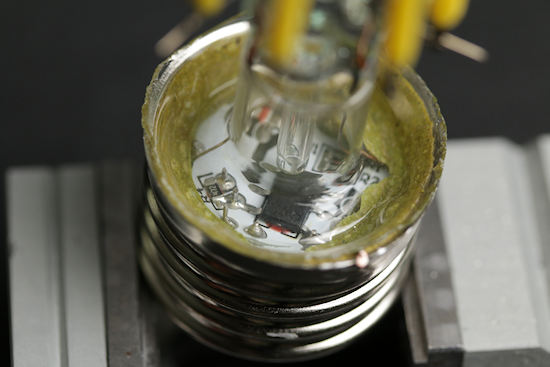
A 230V LED bulb hides electronics in its base
How a dimmer works
The purpose of a dimmer is to reduce the energy supplied to the bulb, so that it lights up less brightly.
Since the electrical network is an AC voltage source, the first idea that comes to mind is to use a variable transformer, which reduces the amplitude of the sinusoidal mains voltage. This is indeed a possibility, but as the size of the transformer increases rapidly with power, it's too bulky and expensive a solution to have been chosen for domestic lighting:
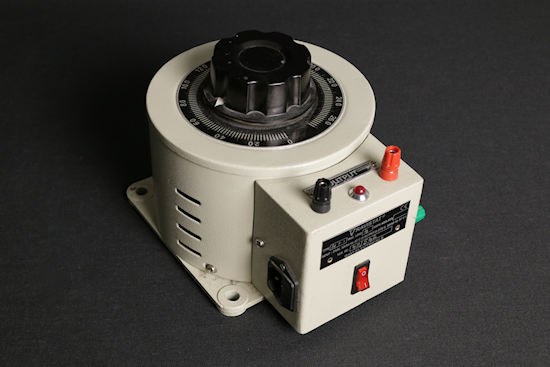
A 4A variable transformer, it's big...
The classic solution consists of a small, ultra-simple electronic circuit made up of just three components:
- a variable resistor, which lets through a tiny amount of current, varying according to the desired intensity
- a capacitor, which stores this current
- a TRIAC, acting as a switch, which lets the current flow to the lamp as soon as the capacitor has reached a given energy level
This mechanism for filling the capacitor and opening the TRIAC occurs within each half-period of alternating current. So, depending on the value of the variable resistor, the capacitor fills up more or less quickly, and the TRIAC is open for more or less time.
To visualize this, we used our new Yocto-Watt-V2-C, which revealed the instantaneous current consumption of an incandescent bulb connected to this type of dimmer during the AC cycle of the mains:
Effect of a conventional dimmer switch on the consumption of an incandescent bulb
These measures confirm that, rather than reducing the amplitude of the sine, the dimmer limits energy by truncating the sine at the start of each phase. This is why the scientific name for this type of drive is forward phase or leading edge dimmer.
This type of dimmer poses two problems compared with an entry-level LED bulb:
- The vertical edge at the start of each period corresponds to a fairly violent voltage rise. As the electronics of the simplest LED bulb include rectifier diodes at the input, followed by a regulating capacitor, this voltage rise causes current spikes at each half-period, resulting in brighter-than-desired light. They can also damage the rectifier diodes and shorten bulb life.
- A TRIAC tends to shut itself down when power consumption is too low. At low currents, with a very energy-efficient bulb, the TRIAC may close unintentionally during a period, causing flickering.
We can demonstrate these problems with instantaneous current measures taken by the Yocto-Watt-V2-C:
Classic dimmer on a basic LED bulb: it doesn't work!
There are indeed consumption peaks when the TRIAC opens, out of all proportion to the dimmer position. In the end, the energy transmitted to the LED bulb doesn't vary as expected at all, which explains why the dimmer doesn't work at all with this bulb.
How to fix the problem?
The root of the problem is the mismatch between a very simple dimmer, which relies on the lamp being a resistive load, and very simple bulb electronics, which relies on the input current being a nice sine wave. The two can't work together.
There are several possible ways of solving the problem:
- replacing the LED bulb by one with more subtle electronics;
- replacing the dimmer with a model better suited to LED bulbs;
- replacing the bulb and dimmer;
- replacing the lamp with an LED lamp with integrated dimmer.
The best solution varies from case to case. Even if we can imagine that most lamps will eventually be replaced by low-voltage LED lamps, it's hard to justify throwing away functional electrical appliances under the pretext of saving the planet. So we won't dwell on this last solution.
Dimmable LED bulbs
Rather than buying the cheapest bulb, if you want to use a dimmer, buy a bulb marked dimmable on the packaging:
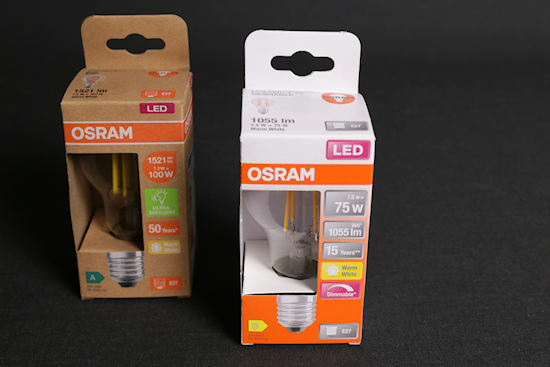
230V LED bulbs are available in a 'dimmable' version
In these improved LED bulbs, more subtle electronics allow energy to be collected using a power-supply tolerant to truncated sine voltage, and the LED to be driven with an intensity that varies according to the average voltage measured on the mains supply. Here's the result obtained using a dimmable LED bulb, using the same dimmer as above, as measured by the Yocto-Watt-V2-C:
Classic dimmer on a dimmable LED bulb
The uncontrolled consumption peaks when the TRIAC is switched on have disappeared, in favour of one or more small, controlled consumption peaks centred on the TRIAC's active period. The energy consumed during each phase increases correctly according to the intensity selected on the dimmer. This bulb is therefore compatible with leading edge dimmers.
Unfortunately, there are a few limitations to the use of dimmable LED bulbs:
- They are not (yet?) available in all formats. In particular, there's a lack of bulbs of this type for the more compact 230V halogen bulb formats, for which we'd often like to use a dimmer...
- Not all dimmable bulbs are created equal. The electronics in this OSRAM bulb are excellent, but there's no guarantee that the bulb you buy for half the price elsewhere will work just as well.
- Dimmable bulbs generally consume slightly more energy than basic LED bulbs, and cost more.
LED lamp dimmers
If you can't find a dimmable LED bulb, you can try an electronic dimmer specifically designed for simple LED bulbs. This would be an electronic trailing-edge dimmer, meaning that instead of truncating the sine at the start of the half-period, it truncates it at the end of the half-period, to avoid the current spike on switch-on that is a problem with these bulbs.
To begin with, here's the effect of a trailing-edge dimmer on an incandescent bulb:
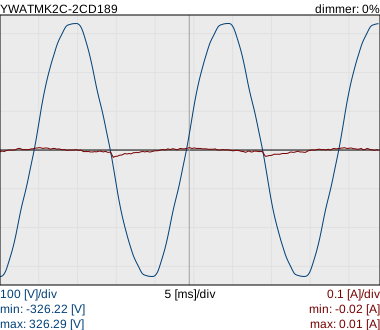
Effect of a trailing-edge dimmer on a filament bulb
We can see that this electronic dimmer can even switch off the bulb completely. However, this has a hidden cost: when the bulb is switched off, the dimmer continues to consume a little something. The Yocto-Watt-V2-C reveals that this represents 0.5 W. That may not sound like much, but it's a 24/7 power consumption. In one day, this switched off dimmer consumes as much as a 100W equivalent LED bulb for almost 2 hours...
If we use it with our cheap LED bulb, we can actually dim the light, unlike the previous dimmer. The Yocto-Watt-V2-C revealed the expected operation of the bulb's power supply:
Trailing-edge dimmer on a non-dimmable LED bulb
At very low intensity, you can observe some flickering, as the maximum voltage presented to the bulb is probably insufficient to guarantee the stability of its regulator. To remedy this, the dimmer has a setting to set a minimum threshold below which it will not fall. But on the whole, it's usable.
Note also that trailing-edge dimmers are not a universal solution for all LED lamps. For LED bulbs, they're fine, but for LED lamps with built-in transformers, they actually cause a problem: the steep falling edge when the dimmer cuts the current is not at all good for inductive loads, such as transformers, and causes a severe overvoltage that can damage the electronics. So don't use a trailing-edge dimmer with a transformer LED lamp...
So how do we know which variator is compatible with a given lamp? In theory, since years 2000, any dimmer intended for LED lighting should indicate the type of load for which it is designed to be used, in accordance with European standard EN 60669-2-1:
- R for resistive loads (filament bulbs, halogens)
- C for capacitive loads (basic LED bulbs)
- L for inductive loads (LED lamps with transformer)
The good phase-down dimmer with which we were able to dim the basic LED bulb is marked R, L, C: it can be configured to choose between leading-edge and trailing-edge, depending on the type of load. We bought it for around 35 EUR in a supermarket.
On the other hand, the product below, bought in the same store for around 85 EUR, does not work with a basic LED bulb:
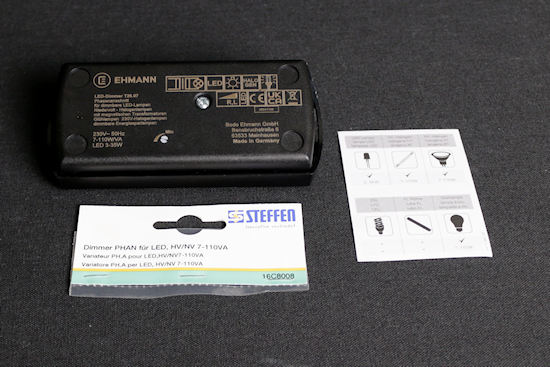
Despite the LED indicator, this dimmer does not work with basic LED bulbs
It may be expensive, but it's an leading-edge dimmer only...
In theory, a good dimmable bulb works just as well with a C dimmer as with an L dimmer.
Verdict
After all these measures, we can give a detailed answer to the original question: Yes, it's possible to use a dimmer with LED bulbs, but...
- Where there is no dimmer, it's best to use the most efficient simple LED bulbs.
- To use a dimmer with an LED lamp with transformer, you need a dimmer with a forward phase (marked L).
- To use a dimmer with an LED lamp without transformer, the ideal solution is to use a good-quality dimmable bulb, if available. In theory, it is not necessary to change the dimmer.
- If no dimmable bulb of the right size is available, the only solution is to use a trailing-edge dimmer (marked C).
- Lamps with electronic dimmers without a real on/off switch should be avoided, as the dimmer consumes power all the time, even when switched off.
And long live the Yocto-Watt-V2-C, which enabled us to observe all this live!