 This week, Yoctopuce is announcing the last two modules to be upgraded to USB-C connectivity: the Yocto-RFID-15693-C and the Yocto-MaxiDisplay-C. Let's take a closer look...
Yocto-RFID-15693-C
The Yocto-RFID-15693-C is a double-width module which can read and write on ISO-15693 standard RFID tags, which are quite common in industry. Its main advantage is that it offers a high-level API for accessing and manipulating tag data. It's important to note that an RFID tag's memory is organized into blocks, and each block must be written to and read in its entirety. Some of these blocks are used to configure the tag; writing to them by mistake is likely to damage the tag, and the risk is all the greater since each ISO-15693 tag model has a slightly different memory organization. In short, the Yocto-RFID-15693-C API allows you to write and read data blocks of arbitrary size by managing the blocks for you. Of course, if you wish to manipulate tag blocks yourself, that is entirely possible.
The Yocto-RFID-15693-C can handle up to about fifteen tags simultaneously, though its range is fairly limited: 10 to 15 cm depending on the size of the tag and on the antenna.
The Yocto-RFID-15693-C is shipped without an antenna, in order to give you the choice of using either Yoctopuce's RFID-Ant-13.56 model or any other 13.56 MHz RFID antenna you can find on the market, keeping in mind that your intended application may influence this choice.
In addition to the RFID functionality, the Yocto-RFID-15693-C offers:
- Two analog inputs to which you can connect switches, potentiometers, and other push buttons
- A NeoPixel-style RGB LED with the option to add more
- A small internal buzzer and the option to connect a small external speaker
In short, the Yocto-RFID-15693-C allows you to easily build an RFID-based user interface, with the option for additional interactions using physical buttons and both audible and visual feedback.
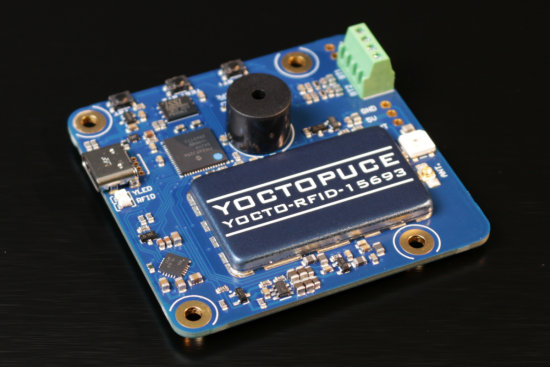
The Yocto-RFID-15693-C
Priced at CHF 158.20, the Yocto-RFID-15693-C is similar in price to the Micro-B version, which is not surprising since the Yocto-RFID-15693 is a fairly recent module.
Yocto-MaxiDisplay-C
The Yocto-MaxiDisplay-C is a double-width module equipped with a 128x64-pixel OLED display with a 62mm diagonal. The API used to control it offers all the basic graphical primitives: lines of variable thickness, rectangles, circles, and even polygons; you can display bitmaps and text, and you can even define your own fonts. The API also offers some unique features you won't necessarily find among the competition:
- A concept of independent graphic layers, which can be active or inactive, which can be moved, and into which different processes can write without risking interference. It's also an excellent way to implement double buffering: you use a visible layer and a hidden layer: you build your drawing in the invisible layer and, once it's finished, you swap the contents of the two layers.
- You can create standalone animations: rather than "drawing on the screen", you can draw within an "animation" that the module can then play at will completely independently, even without a USB connection
The Yocto-MaxiDisplay-C also offers 6 analog inputs for interfacing with buttons or potentiometers, so you have everything you need to create a navigation interface with up/down/left/right/yes/no controls.
Limitations
OLED technology has a significant limitation: the organic LEDs that make up the screen's pixels slowly lose brightness as they are used. Consequently, if your display always uses the same pixels, the screen becomes marked after a few weeks with some pixels glowing less brightly than others. This is why we recommend alternating between positive and negative display modes; the module can even do this automatically for you. This won't prevent the pixels from aging, but at least they'll all do so at roughly the same rate.
Note, however, that unlike the Yocto-MaxiDisplay, the OLED panel on the Yocto-MaxiDisplay-C is not soldered directly onto the module but plugged into a ZIP connector, which makes it fairly easy to replace if necessary.
The Yocto-MaxiDisplay-C has a blue OLED panel; the Yocto-MaxiDisplay is available in two versions: blue and green. However, we've decided to discontinue the green version given the low number of units we've sold so far. But since the panels are now easily interchangeable, if you'd like a different color, contact Yoctopuce support, we should be able to work something out :-)
Finally, note that the USB-C version is about 1mm thicker than the Micro-B version. Since the USB connector is located directly beneath the OLED panel, we had to make a small compromise to fit the USB-C connector, which is slightly bulkier than a Micro-B connector.
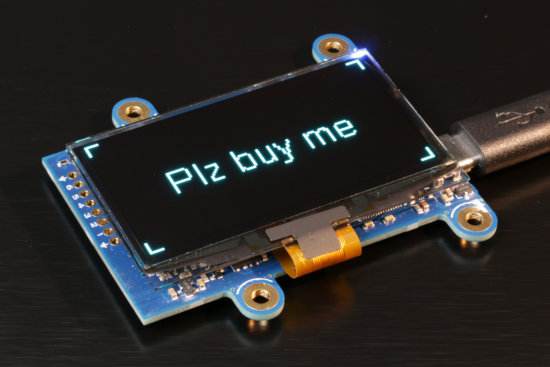
The Yocto-MaxiDisplay-C
At CHF 82.--, the USB-C version of this display is much cheaper than the Micro-B version. The new OLED panel model we're using costs us significantly less than the one in the old version.
Conclusion
After two years of hard work, the transition to USB-C connectivity for Yoctopuce products is finally complete. Next time, we'll take a look back at the work accomplished, the pros and cons of USB-C compared to the Micro-B format, and what's coming next....