 Once again this week, Yoctopuce announces two new USB Type-C conversions: Yocto-Maxi-IO-V3-C and Yocto-LatchingRelay-C. Let's take a quick look...
Yocto-Maxi-IO-V3-C
The Yocto-Maxi-IO-V3-C is the big brother of the Yocto-IO-V2-C. This module provides eight inputs/outputs isolated from the USB bus, which you can independently configure as input, output, open drain or not. By default, the Yocto-IO-V3-C can produce or receive signals between 3 and 5 volts. But if you supply it with an external power supply, you can work up to 28V and output up to 250mA per channel, enough to drive small motors if you feel like it.
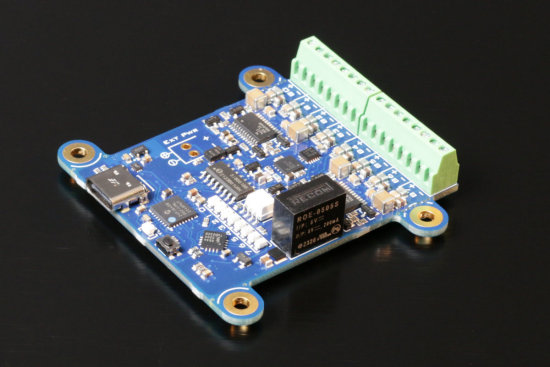
The Yocto-Maxi-IO-V3-C
The Yoctopuce API that manages the various channels offers some handy little features: you can of course read/write each channel independently, but you can also read/write all 8 at once. You can also send a single command to send a pulse of arbitrary length to the channel of your choice. Of course, you can receive a callback every time the state of an input changes, so there's no need to waste CPU time polling.
In terms of price, no surprise, as the Yocto-Maxi-IO-V3 was a fairly recent module, there's no noticeable difference between the price of the Micro-B version and that of the USB-C version.
Yocto-LatchingRelay-C
The Yocto-LatchingRelay-C is a little different from the other relays offered by Yoctopuce. It's a bistable relay: it only needs electricity to change state. This means it retains its state if you disconnect it, unlike a conventional relay, which will return to its resting state as soon as it's deprived of electricity. So what's the practical benefit of this feature?
- Whereas a conventional relay consumes a non-negligible amount of electricity when it's active, a bi-stable relay consumes electricity only when it switches from one state to the other.
- As a result, the relay coil doesn't heat up.
- You can easily build a low-consumption system that switches on, calculates the state of the relay, switches the relay if necessary, and then switches off.
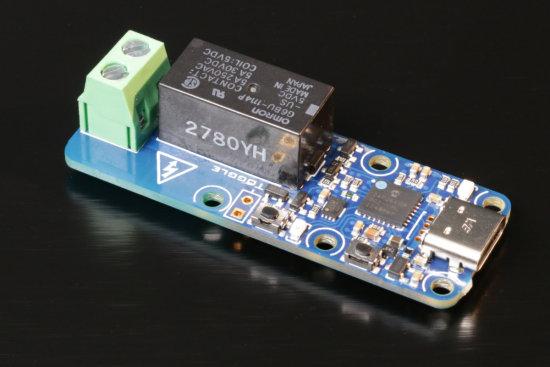
The Yocto-LatchingRelay-C
A subtle detail: the Yocto-LatchingRelay-C has a button for manual switching and a pair of contacts that will do the same if connected, for example, to a push-button. This makes it easy to build automations such as a lamp that can be controlled both manually and via USB or Wifi, or a mechanism that stops automatically once it reaches its limit. In short, the Yocto-LatchingRelay-C is a rather specific product, but there are situations where you'll surely be glad to have it :-)
Here too, as the Yocto-LatchingRelay is a fairly recent module, there's no noticeable price difference between the Micro-B and USB-C versions.