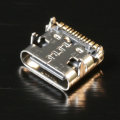
 Yoctopuce is quietly continuing its migration to USB-C connectivity. This week, we're releasing two new modules equipped with a Type-C connector: the Yocto-PWM-Rx-C and the Yocto-CO2-V2-C. Let's take a look at what they have to offer.
Yocto-PWM-RX-C
PWM (Pulse Width Modulation) signals are very common in industry. They allow simple signals to be transferred in the form of pulses of variable length transmitted at a generally fixed frequency. Quite logically, the Yocto-PWM-Rx-C can calculate the signal frequency and duty cycle, i.e. the ratio between the pulse length and the signal period, but that's not all.
The Yocto-PWM-Rx-C can also count the pulses it sees and calculate the number of pulses per second or minute, which is very useful for interfacing sensors that communicate using pulses whose frequency is proportional to their signal. This is typically the case with many flow meters, which are often built around a small turbine driven by the fluid passing through the flow meter, producing one or more pulses per revolution. Note, however, that while this technique is very useful for totaling the amount of fluid that has passed through the flow meter, measuring the amount of fluid per unit of time can be problematic. The measure becomes ambiguous when the fluid slows down: there comes a point when the pulses are so far apart that you have to arbitrarily decide that the fluid has stopped without being really sure. The Yocto-PWM-Rx-C solves this problem by allowing you to configure a maximum period.
The Yocto-PWM-Rx-C can also handle signals produced by electromechanical devices, which typically tend to generate bounces that can count as additional pulses. You can configure the Yocto-PWM-Rx-C to ignore these spurious pulses.
An important detail is that the Yocto-PWM-Rx-C is an isolated module: the measuring part is electrically isolated from the USB part, which prevents problems if you need to measure signals that do not share the same ground as your USB port.
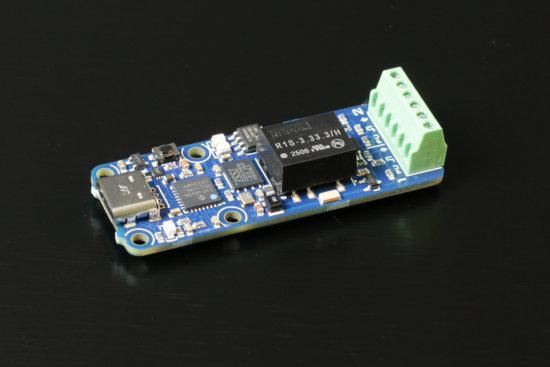
The Yocto-PWM-Rx-C and its USB-C connector
In terms of price, the Yocto-PWM-Rx-C costs CHF 58.90, which is CHF 3.40 more than the Micro-B version.
Yocto-CO2-V2-C
The Yocto-CO2-V2-C is a sensor that allows you to measure the CO2 level in the air between 0 and 4%. A maximum of 4% may seem a little low, but normally there is only 0.04% CO2 in the air, and the exposure limit for a healthy human is 3% over a period of fifteen minutes.
The Yocto-CO2-V2-C is based on a Sensirion SCD30 sensor. It is an NDIR (Non Dispersive Infrared Sensor), a technology that is significantly more stable over time than the inexpensive chemical sensors that are widely available.
The Yocto-CO2-V2-C is also equipped with temperature, humidity, and pressure sensors that are used by the module to compensate for CO2 sensor measures depending on atmospheric conditions. These temperature, humidity, and pressure measures are published by the module, in other words, the Yocto-CO2-V2-C also contains the equivalent of a Yocto-Meteo-V2-C.
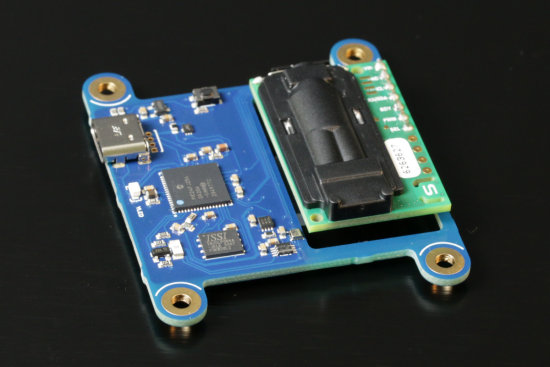
The Yocto-CO2-V2-C
If you read this blog regularly, you must be starting to get the picture. The unit price of a Yoctopuce module is calculated at the time of its release as three times its component cost and is not changed thereafter, barring exceptional circumstances. Imagine our surprise when we calculated the price of the Yocto-CO2-V2-C: the SCD30 and a few other components now cost us significantly less than in 2018, when the Micro-B version was launched. We have therefore lowered the price of the Yocto-CO2-V2 from CHF 180 to CHF 131 and set the price of the Yocto-CO2-V2-C at CHF131.20.
That's all for this week.